Friday, 21 June 2013

Midsummer (what summer?) ramblings

Alliums, the cheerleaders in my border! 
Summer solstice tonight, that means the days will start getting shorter as from tomorrow.  Hmmm, wondering if we actually will catch up in the garden ever!

The big success we've had this year is our perinneal borders, finally things have established and right now the garden is a big, blowsy, colourful show.  These long evenings are perfect for pottering outside.


Euphorbia

my potager with ransomes, lemon balm, chives, thyme 

Last of the purple sprouting broccoli (Spooky helping himself)


Today it is raining, we need the rain as it has been a very dry June (after a very cold May) which has made things bloom later but now we need some moisture to get everything growing.  The big bonus about things being later is getting to have bluebells still blooming in the garden, I love them.


bluebells under my kitchen window


Here's hoping we get some fair weather in July to extend whats left of what seems to be a very short summer so far.

Monday, 7 January 2013

Growing and eating wishlist for 2013

Happy New Year!

It's been mild, dry and windy so far.  A brief respite from the mud and rain for our animals and a chance to get out in the garden for us.  Yesterday Paul started clearing the old chicken run area out, we moved the chickens to their free range area a couple of years ago and the old run has been left vacant for a while.  The plan this year is to move our existing fruit bushes into it.  At the moment our raspberries, blackcurrants, redcurrants and gooseberries are in the same part of the garden as the chickens and last year became overgrown and neglected, however, they did provide a lovely space for Fiona, our Cream Legbar, to lay all her eggs, it meant I was crawling about under scratchy plants trying to find them, not much fun.  By moving the plants we will be able to give them all more space and light, resulting in more fruit (and less lost eggs!)this summer.

Getting in the garden on the first weekend in January has also made us keen to plant and eat as much as possible this year.  Last night we feasted on a stew made from the last of our Cavalo Nero (loosely adapted from a Nigel Slater recipe), I cooked pancetta, onion, chorizo, tomatoes and some chunks of potato in red wine and stock for about 30 minutes, then added a couple of tins of butter beans, and some huge handfuls of roughly chopped Cavalo Nero - cooked for another 10 minutes to let the kale wilt and then seasoned with smoked paprika, a splash of red wine vinegar and topped with some parsley (we still have some growing in the polytunnel).  I have to say it was the best dinner this year (;-)).  So with the thought of making the most of our garden I have decided to list things that I would most like to grow in the garden (sadly trying to remember that we don't live in the south of the UK and are very much restricted by what we can grown up here in the far north).

Vegetable Garden Essentials 
(things we already grow, and eat and can't live without)

Cavalo Nero (of course)
Kale (the bigger type than Cavalo nero, can't remember it's name)
Onions and Shallots
Broad Beans
Garden Peas
Tomatoes
Courgettes (especially Gold rush, beautiful yellow sunny ones)
Spinach (the perpetual one works best in our garden)
Lettuce - Romaine, Cos, and Rocket (although not sure if Rocket is a lettuce?)
Beetroot
Rhubarb
Horseradish
Swiss (rainbow?) chard
Chili Peppers (inside the house, bit of a cheat but I love them)
Flat and curly parsley

Nice to have 
(have grown them before and want to grow again)

Purple Sprouting Brocoli - for some reason it hasn't done very well last few years
Pink Fir Apple Potatoes - had a potato free couple of years, but these are my faves
Strawberries - I grow the alpine ones in the herb garden but grown the 'big' ones for a while
Runner beans - taste great, hard to grow up here
Sweetcorn - grew in the garden once (a hot summer) then in the polytunnel but not very succesfully
Brussel sprouts (grew them in our last garden but they take up a lot of space)

Dream on...
(if only we didn't live in Aberdeenshire)

Aubergines
Squash - any kind, especially wee patty pan ones
Bell Peppers (especially those light green ones you get in Spain)

last year in the hen's free range garden (old raspberry canes behind their shelter)

As ever living up here, I think the worst of our winter weather has still to arrive (usually after my first snowdrops have appeared), but I love spending the long nights planning what to do when spring does arrive.


Tuesday, 27 November 2012

Whisky & Ginger (Marmalade) Fruit Loaf

This is a wonderful recipe, perfect for all times of year and especially around Christmas.  The joy of this Whisky Ginger loaf is that you make two at a time, I usually freeze one and then the other can be eaten.  Alternatively you could freeze both as they keep beautifully, but only if the rest of your family haven't realised you have baked them! (the smell as they come out of the oven is too good to miss).

The recipe is adapted from the orignal recipe taken from 'The Three Chimney's' cookbook by Shirley Spear.  Still on my wishlist of places to visit and eat, I enjoy cooking from this book which feels like part journal/part travel guide, with truly stunning photos.  *I will include the orginal options in the recipe for information.

INGREDIENTS

You will need;

170g raisins
170g sultanas
140g currants
250 ml water
115g butter
140g soft dark brown sugar
3 eggs beaten
280g self raising flour
2 tsp mixed spice
2 heaped tbsp Ginger preserve (*original uses marmalade)
30g roughly chopped almonds
75g chopped mixed peel
75g chopped crystallized ginger
75g chopped glace cherries* (original just uses 115g of peel and 115g of cherries)
3 tablespoons of whisky

2 x 2lb loaf tins, greased with a bit of butter and lined.  Preheat oven to 180oC (I use my Aga, grid shelf on the bottom of the top oven, cold plain shelf on second set of runners).

METHOD

Weigh out the raisins, sultanas and currants.  Place in a large saucepan along with the water, sugar and butter.

Heat gently until the butter and sugar have melted together and the whole kitchen smells of delicious sweet, warm fruit.  Don't let the mixture boil.


Take the pan off the heat and allow to cool slightly.  Now assemble the rest of your ingredients, and when the fruit mix has cooled, mix through everything else (sieve the flour and mixed spice).


I add the Ginger preserve and whisky last, giving it all a quick stir together to make sure everything is mixed through.


Split the mixture between two greased and lined 2lb loaf tins (I don't have two the same size but it doesn't seem to matter).  Bake for about 1 hour, the finished cake should be lovely and brown.


Out of the Aga!  Leave the cakes to cool in their tins for about 30 minutes before putting on a wire rack to cool.  My Aga was quite hot when I baked these, so they only took 50 minutes and the one in the silicon 'tin' is slightly over (well lets say a bit more caramelised!!).  But it still tastes delicious.  Keep in an airtight tin until ready to use or wrap well and freeze (defrost thoroughly before using).

The finished Whisky Ginger loaves


Monday, 16 July 2012

Easy Garden Soup for a Summer (?) Day


Well, Summer what can I say?  Wettest June on record, greyest too.  I've been putting rugs on my horses as the temperature, wind and driving rain has been making them miserable.  The garden has suffered, thank goodness for the greenhouse and polytunnel or there would be nothing to eat from the garden this year (slugs are doing well but I don't fancy eating them!).

To cheer myself up on another wet Monday I've made soup, I know it sounds odd and shouldn't make me feel cheerful - but it worked.


It's sort of based on a summer minestrone or soup au pistou but I just used what I had in the fridge and polytunnel.

You will need;

Olive oil (scant amount - 1 tablespoon?)
One onion, finely chopped
Two carrots - peeled and sliced
Three large celery sticks, chopped
Two courgettes (I had one yellow and one green - looks pretty)
Handful of flat leaved (Italian) parsley
Tin of ready chopped tomatoes (organic)
1 teaspoon of Marigold Swiss Vegetable Bouillion powder
salt and pepper

Method
Saute onion, carrot and celery in olive oil for 5 minutes


Courgettes and parsley from the greenhouse


Add sliced courgettes to the vegetable mix and soften gently for about 5 minutes.  Next add the tin of tomatoes, then fill the empty tin with water and rinse the leftover tomatoes and water into the pan as well.


Now I added my chopped parsley and the parsley stalks chopped very fine too.  Bring to the boil and simmer for about 15 minutes.  Do not overcook otherwise the vegetables will lose their colour and crunch.

After 10/15 minutes taste and adjust seasoning.  I added salt and pepper and a couple of dashes of Piri Piri sauce, to give it a bit of warmth.

Serve topped with some shavings of a hard cheese (Parmesan, Pecorino, Cheddar etc, I used Manchego it was all I had in the fridge).

Other ideas to top it, a drizzle of basil or garlic infused oil, a swirl of pesto, some crumbled goats cheese, I tend to go with whatever I have.

So delicious, colourful and healthy - it almost makes up for our lack of summer (almost).

Thursday, 5 April 2012

Hot Cross Bun (Bread) and Butter Pudding just in time for Easter

I made this last week and enthusiastically tweeted about it, promising to post the full recipe and photos on here later that day (ahem!).  So here we are a week or so later.  Anyway, life has been busy I've finished painting the outside of my stables, we've been planting up plants in the greenhouse ready for planting out later and Paul has been getting on with the new deck outside.  Spring really felt like it was springing, until this Monday when we had a slight dusting on snow and then on Tuesday 3rd, my Dad's birthday, he was up visiting from Glasgow, we woke up to 7 inches of snow.  Winter not quite ready to let go of us yet!   It was sad to see our tiny narcissi daffs flopped over underneath the snow but hopefully it will warm up again soon (-2oC when I woke this morning).

Hey ho, back to the task in hand.  Here is my recipe for a bread and butter pudding made with slightly stale hot cross buns, it was truly delicious.  This recipe is not terribly sweet as I served it with Vanilla ice cream, if you prefer a sweeter pudding I would add a couple more tablespoons of caster sugar in the custard mix.

You need;


6 hot cross buns;
softened butter (enough to spread over the bread and grease the dish);
6 fl oz double cream;
6 fl oz milk;
2 tablespoons caster sugar;
3 large eggs;
2 tablespoons brown or demerara sugar.

Preheat oven to 180oC - I baked in Aga, shelf on the bottom of the top oven, plain shelf on the 2nd set of runners.

Slice up the buns, across the way.  Butter both sides and layer in a buttered dish.


 Combine the cream, milk, eggs and caster sugar - mix well in a jug.


There is almost a pint of custardy mix.  Pour this over the buttered buns in your baking dish. 


Finally sprinkle brown sugar over the top and bake for around 35 minutes in a moderate oven.


Remove from the oven, leave to cool for about 5 minutes, then serve with your choice of ice cream, custard, double cream or all 3!! 

The finished pudding - and very delicious it was too.  Happy Easter everyone!

Sunday, 4 March 2012

Come on Spring - more springing please!

Goodbye February, you've been a short but sweet month, complete with Scottish Higher prelim exams (daughter), a ski trip to Meribel in the Three Valleys (en familie), France and then rounded off with tonsilitis (youngest son) and a broken hand (oldest son)!

Me and the kids skiing - blurry photo!

View down the Doron piste from the chalet we stayed in - iPhone photo

In Aberdeenshire we had the warmest recorded temperatures for February since 1998.  Zac and Brea went from winter rugs to no rugs (naked horses, the nicest thing is to see them rolling, it makes me so happy!) and now we are back into winter rugs as the temperature has dropped this weekend.

I've only got a few photos for this month, I had taken our small point and shoot (ie idiot proof) camera to France for skiing, so I could stick it in my ski jacket and not worry about lens caps etc.  Unfortunately, the camera was not idiot proof enough for me as I managed to get a sticky finger print on the lens, which I didn't realise until I got home and loaded the pics on the pc - lots of nice 'soft, smudgy' focus pics!  Never mind, you live and learn.  The photo below was the day we arrived back in Aberdeenshire from France, we brought some snow home with us you see - Dash and Coco enjoyed being back home after their stay at the local Pet Hotel.

We have crocuses out in the garden at the moment, no daffodils or narcissi yet but spring is definitely arriving according to the amounts of garden birds singing, courting and fighting.
home sweet home
I love this time of year, so much promise for long days in the garden and stables ahead.

Friday, 3 February 2012

Stuff that works for me in cold (baltic) weather!

Another very cold and absolutely freezing day today!  However, the sunshine and clear blue skies make up for the fact that it's still -6oC at 10.00 am.

Having kept animals at home for the last ten years I have found the following things really help when we hit the 'very cold' part of winter.  This year hasn't been so bad so far, last year our lowest temp was -27oC and we stayed at below -20oC for a week.  All this is fine for us humans, central heating, an Aga, a couple of log burning stoves and even some electric fan heaters kept us warm inside but dealing with our horses and chickens outside was more challenging.

Here is my list -
  • Musto snug jodpurs - warm legs and happy me
  • Muck boots - these are neoprene wellies, and keep your feet warm and dry (but they do really stink when you take them off, I Febreze mine and my OH's!!)
  • I have two galvanised waterers for our chickens - one is always defrosting/defrosted inside the house, ready to be swapped over for the outside one once it freezes (and this can happen a couple of times a day if it's -20!)
  • Last year we finally bought and fitted a heatsource tape to the water pipe that supplies my stables - it has a built in thermostat which automatically heats the length of blue water pipe if the temp drops below 3oC.  It means that I can fill the horses water buckets in the stable and also outside without having to fill containers from the house and move to the stables/field by wheelbarrow.
  • I now use large Tub Trugs as water buckets in the horses stables and in my fields (especially as my automatic waterer freezes solid pretty quickly).  They are easy to remove the ice from and flex a bit if they get frozen solid.
  • I use a kids (clean) shavings fork to lift ice out from the buckets before I refill them with water - bit basic but stops the water freezing again so quickly.
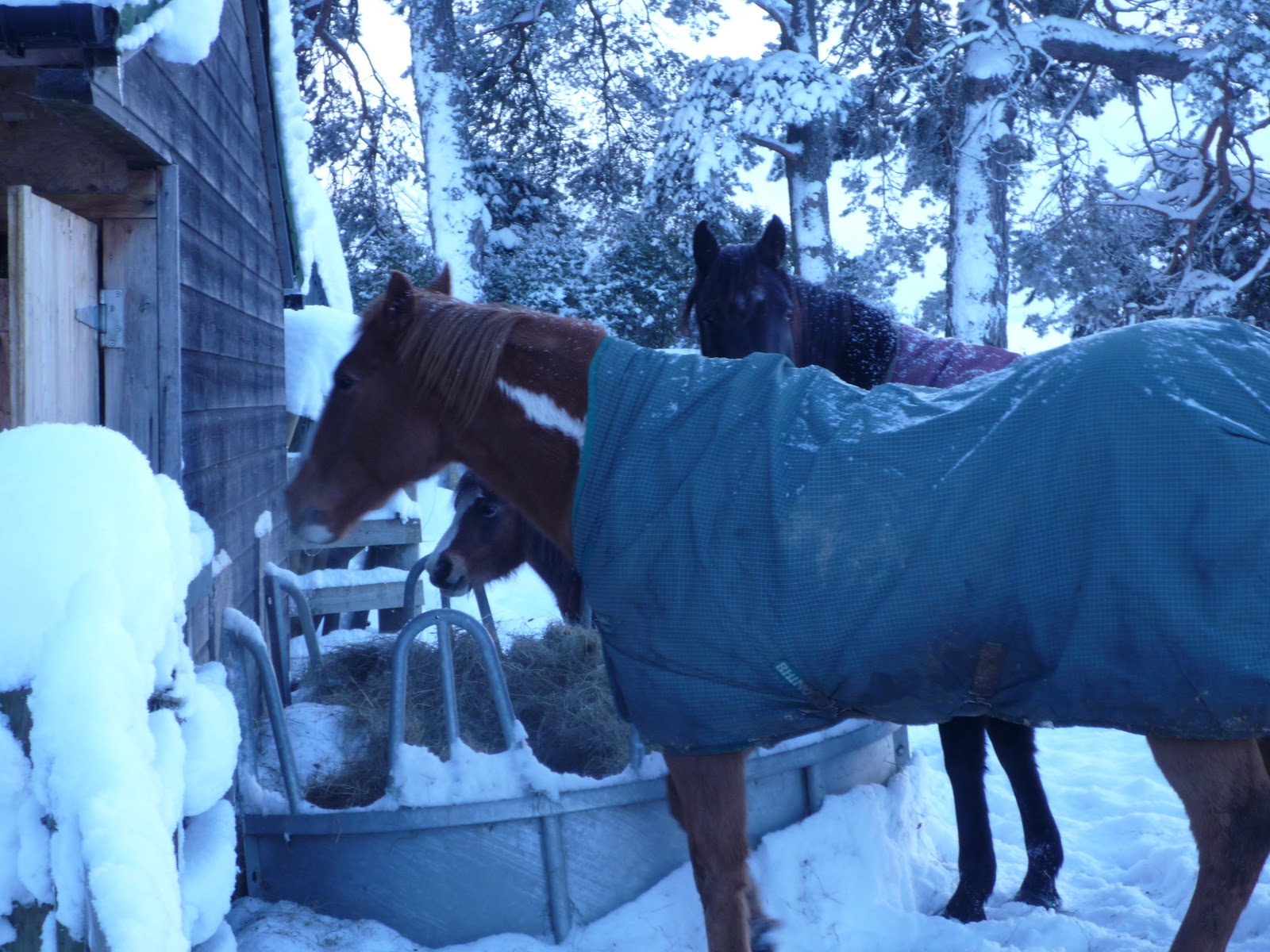
  • We have a section of hardstanding in our paddock nearest the stables, I feed the horses hay from a round (Highland Cattle!) feeding ring there, it stops them standing in mud and means I don't have too far to go to move hay.
  • When the temp is really cold, I feed the horses in their stables, do rug checks etc etc and then I leave the stable doors and the gate to the field open.  This means they are free to come and go as they please.  My two big horses moved home with us from Calgary, Alberta and are used to cold temperatures, but I have found on really cold nights that they keep warmer if they can move/walk around rather than standing in a loose box all night.  This seems especially true with Zac, my paint horse, he is around 24 years old and is quite stiff in his pelvis so keeping moving is much better for him.
  •  I keep a chicken feeder filled up with layers pellets under a small weather shelter at all times.  The chickens also get two poultry corn feeds a day, and an extra feed of grain at night just before roosting.  My theory is that this keeps them a bit warmer when they are roosting!
  • We have a automatic pop hole opener on our chicken house, which is great, but sometimes if there is a lot of snow I dig small paths for the chickens to go from their house, to the water, to the feeder etc.  A sprinkling of hay outside their door can help them jump down, they don't seem to like the initial shock of going onto cold snow.  We just rake it up again once the hay has gone. 

A list of simple things, but they mean I can look after my animals, even when it does feel like we're in a freezer outside.